A Norwegian IoT operator has published a list of the best SGP.32 providers of 2026, and the first name on it is the Norwegian IoT operator. I don’t hold that against Com4. Everyone who writes these lists puts themselves at the top. What makes this one worth reading is the second half: it gives straight caveats on every vendor, including itself. Soracom has spent the week sharing its place on the list across LinkedIn, so let’s look at what the list says, what Soracom said in reply, and what a buyer should actually take from it.
SGP.32 providers 2026: the Com4 list at a glance
- What happened: Com4 published Best eUICC and SGP.32 IoT eSIM Providers in 2026, with provider facts checked in November 2026.
- Who made the list: Com4, Telenor IoT, Tele2 IoT, Onomondo, Soracom and Telia.
- The new name for this site: Soracom, which Com4 rates for teams that want to orchestrate several operators’ profiles on one eSIM from a cloud platform.
- Soracom’s reply: its SGP.32 eSIMs and Connectivity Hypervisor have been generally available since July 2026, in card and chip form factors.
- The useful bit: Com4’s own advice to buyers is to check which operator profiles are actually available in your markets today. Soracom agreed with it in public.
Who wrote the list, and why that matters
Com4 is an Oslo-based IoT connectivity provider, founded in 2011 and part of the Wireless Logic group since 2021. We profiled the group’s approach in Wireless Logic and SGP.32, and Com4 itself in more depth over on IoTPortal. If you are deploying in the Nordics, the IoT eSIM in Norway guide on euicc.co.uk puts Com4 alongside Telenor and Telia.
Since that guide was written in August, Com4 has moved from “SGP.32-ready” marketing to SGP.32 SIMs available to order. That is a real step, and it is why it can now put itself on its own list with a straight face.
So read it as what it is: a vendor’s buyer’s guide. Every entry is drawn from the providers’ own websites and press releases, and Com4 says so on the page. That is more honest than most of these lists manage. It even tells you its own support runs from 08:00 to 16:00 on business days, which is the sort of detail rival marketing teams usually bury. I’d rather have a vendor list that admits its own office hours than an “independent” one that doesn’t.
The six SGP.32 providers, side by side
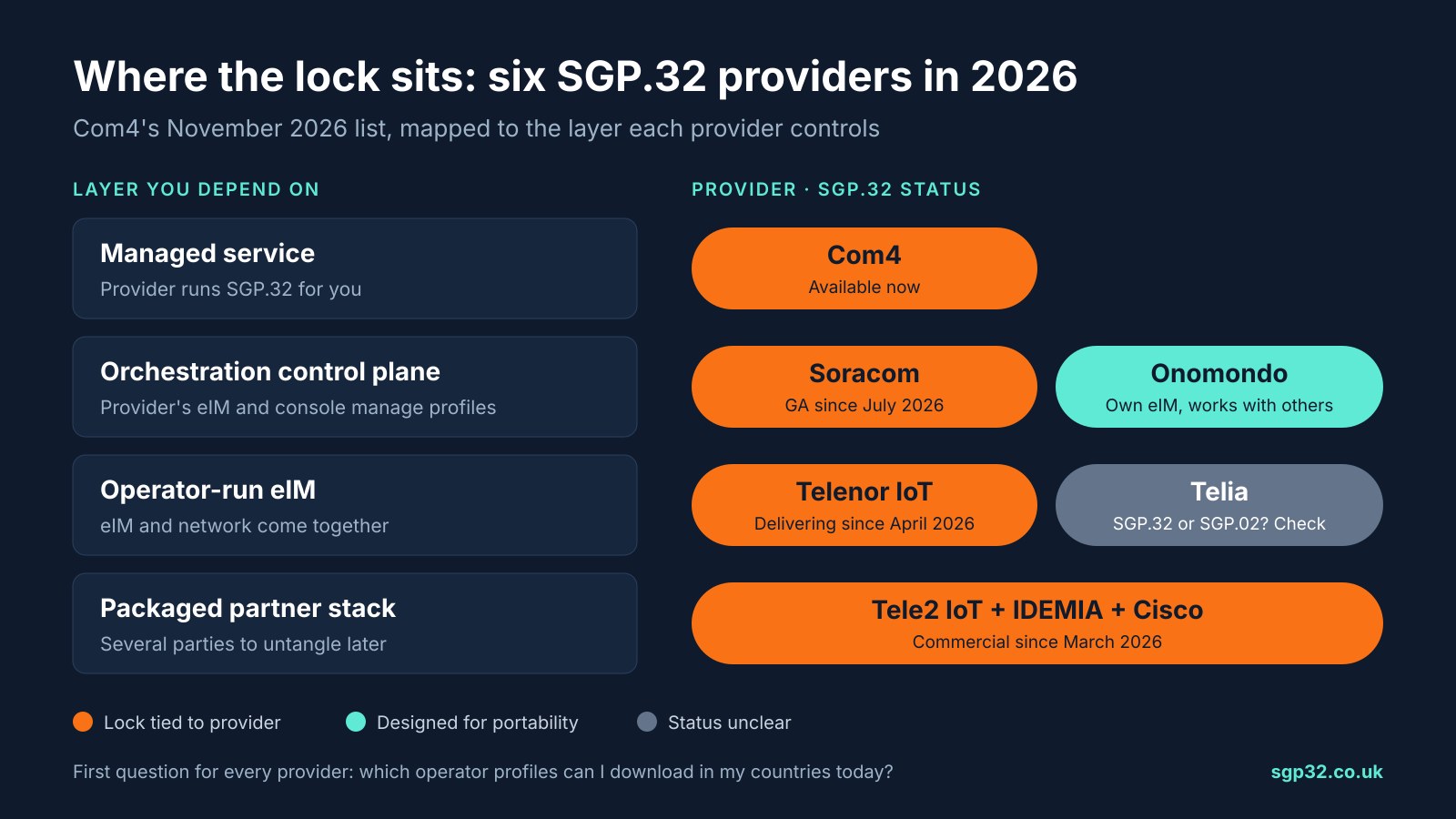
Here is the list as Com4 sets it out, with the lock-in question this site keeps asking added in the last column. That column is mine, not Com4’s.
| Provider | SGP.32 status (Nov 2026) | Who runs the eIM | Where the lock sits |
|---|---|---|---|
| Com4 | Available now | Com4, as a managed service | Managed service and the Polaris platform |
| Telenor IoT | Delivering since 17 April 2026 | Telenor IoT | Operator-run eIM and which third-party profiles it allows |
| Tele2 IoT | Commercial since March 2026 | With IDEMIA and Cisco | A packaged three-party stack |
| Onomondo | Available; own eIM since September 2026 | Onomondo, usable with other providers | Lowest of the six, by design |
| Soracom | Generally available since July 2026 | Soracom, via Connectivity Hypervisor | The orchestration control plane |
| Telia | Check with Telia | Telia eSIM ecosystem | SGP.02 legacy versus SGP.32, by market |
Source: Com4’s provider list, checked November 2026; lock-in column is sgp32.co.uk analysis.
Soracom: the new name on this site
We have covered Soracom before, mostly in someone else’s story: as part of Kigen’s partner ecosystem in SGP.32 has moved into the RFP, and in our July round-up, the month it went commercial. This is the first time it has been the main subject.
The facts are simple. Soracom is a Tokyo-listed IoT connectivity platform with offices in Seattle and London. On 8 July 2026 it moved its SGP.32 eSIMs and Connectivity Hypervisor from pre-order to general availability. Connectivity Hypervisor is its orchestration layer on top of a standard eUICC, eIM and SM-DP+ stack. It can add, remove and switch both Soracom profiles and third-party operator profiles over the air, and it falls back to a Soracom profile if the target profile is not available.
The name is a good one. A hypervisor in a data centre lets you run several operating systems on one box without each one caring about the others. Soracom’s pitch is the same idea for a SIM: several operators’ profiles on one eSIM, managed from one console and API. As a picture of what SGP.32 is for, it works.
Soracom’s reply to the list was graceful, too. Com4 praised the orchestration and added a caveat, and Soracom repeated the caveat back as “good advice” and offered to walk buyers through it. That is the right way to take a compliment that comes with a condition.
The caveat both sides agree on
Here is the line I would underline. Com4 says Soracom’s broader third-party profile availability depends on partner operators finishing their integrations. Soracom said much the same in its own July release. Neither is hiding it.
It is also not a Soracom problem. It is the SGP.32 problem. As I argued in the RFP piece, certified eUICCs are shipping and certified eIMs are live, so the bottleneck has moved to the operators. IoTPortal mapped the whole SGP.32 readiness chain recently, and the operator link is still the weakest one. A hypervisor that can host ten operators’ profiles is only as useful as the number of operators who have actually plugged in, in the countries you need.
Look down Com4’s caveats and the same theme runs through all of them. For Telenor, check which third-party profiles you can add. For Tele2, check how easily you could move to another eIM later. For Telia, check whether you are buying SGP.32 or the older SGP.02. Six vendors, one question: what can I actually switch to, today, and can I leave?
Where the lock-in sits for each provider
This is where the list connects to the argument this site has been making since August: SGP.32 doesn’t end operator lock-in, it moves it somewhere else. Com4’s six give you a neat spread of where it ends up.
- Soracom puts the value in the orchestration layer, the same control-plane position we looked at in our Eseye profile. That is no criticism. A good control plane is worth paying for. Just ask how you would get your fleet out of it, which is the eIM portability question. If the eIM itself is new to you, IoTPortal has a plain-English explainer on what an eIM is.
- Onomondo sits at the other end, with an eIM it says works with other providers’ connectivity. We dug into that in Onomondo and SGP.32.
- Com4 runs SGP.32 as a managed service, which is the operational kind of dependence: you get the expertise, but you never build it in-house.
- Telenor and Telia are operators, so the eIM and the operator relationship come together. That is convenient until the day you want a profile they don’t offer.
- Tele2 packages IDEMIA’s eSIM ecosystem with Cisco’s orchestration, which is three parties to untangle if you ever want to change one of them.
None of these is wrong. They are different trades. The mistake is not knowing which one you have made.
What to ask before you shortlist
Com4’s page ends with nine questions, and they are good ones. I’d boil them down to five you should ask any provider on this list, or any other:
- Which operator profiles can I download in my countries today? Named, by country, separate from the ones that are “in progress”. This is the caveat Soracom and Com4 agree on, so make every supplier answer it.
- Who runs the eIM, and can I re-point the eSIMs to another one? If the answer is vague, the lock is in the eIM.
- Is the eUICC certified, and against which SGP.32 version? Most of the market still designs against v1.2, with v1.3 certification only starting to land.
- Where does the IPA run? In the eUICC or in the device makes a big difference to your module and firmware choice. See IPAe vs IPAd and SGP.32 modem compatibility.
- What does the first profile give me on day one? The bootstrap profile is where a lot of deployments come unstuck.
Com4 makes one more point I agree with: SGP.32 doesn’t replace multi-IMSI SIMs. Plenty of fleets will run both for years. For the full checklist, see what to ask your eSIM provider, and for how the UK players fit together, the UK SGP.32 landscape.
My take
A vendor list written by a vendor is not independent, and Com4 doesn’t pretend it is. But it is more useful than most of the “top ten” pages floating around, because it puts the right caveat against every name, including its own.
Soracom deserves its spot. It built the orchestration before the market asked for it, and it has been open about where the limits are. The real test for every name on this list arrives over the next year. Can it show a buyer a named, working, switchable profile in the country they need, rather than a logo slide of future partners? When that list of live profiles gets long, SGP.32 will have properly arrived. I’ll keep tracking it here.
Quick answers
Which providers offer commercial SGP.32 IoT eSIMs in 2026?
Com4’s November 2026 list names Com4, Telenor IoT (delivering since April 2026), Tele2 IoT with IDEMIA and Cisco (since March 2026), Onomondo (own eIM since September 2026) and Soracom (generally available since July 2026). It says Telia’s SGP.32 status should be checked with Telia.
Is Soracom’s SGP.32 eSIM generally available?
Yes. Soracom moved its SGP.32-compatible IoT eSIMs and Connectivity Hypervisor orchestration from pre-order to general availability on 8 July 2026, in card and chip form factors.
What is Soracom Connectivity Hypervisor?
It is Soracom’s SGP.32 orchestration layer. It manages several operators’ profiles on one eSIM over the air, including third-party operator profiles, with fallback to a Soracom profile if a target profile is unavailable.
What is the main caveat when choosing an SGP.32 provider?
Check which operator profiles you can actually download in your markets today. Third-party profile availability still depends on operators finishing their integrations, and that varies by country.
Is Com4’s list independent?
No. Com4 is one of the providers it reviews and is part of the Wireless Logic group. Its facts come from the providers’ own websites and press releases, which the page states.