The handbook in one paragraph
SGP.32 is the GSMA standard that lets an IoT device’s eSIM download and switch mobile operator profiles remotely, with no screen, no user and no SIM swap. A cloud platform you choose (the eIM) tells software on the device (the IPA) to fetch a profile from an operator’s server (the SM-DP+) and install it on the eSIM chip (the eUICC). This handbook takes you from “what is an eSIM?” to a buying checklist for 2027, in fourteen short chapters. Each one ends with a link to the full guide on that topic.
I have spent a long time explaining SGP.32 one question at a time: what an eIM is, why a router “with eSIM” may not be SGP.32 at all, why a new profile does not magically fix poor signal. This handbook is all of those answers in one place, in the order you actually need them. Read it top to bottom if you are new to IoT eSIM, or jump to the chapter you need. It is free, it stays free, and I update it as the standard and the market move. This is the 2027 edition, last revised on 24 November 2026.
Contents
Free PDF · 14 pages
Get The SGP.32 Handbook as a PDF
Print it, share it with your team, or take the buyer’s checklist into your next supplier meeting. I’ll email you a copy, plus one note on UK providers a few days later. Unsubscribe any time.
Chapter 1What an eSIM really is
An eSIM is not a different kind of mobile service. It is the same SIM identity, held differently. Three terms do most of the work, and mixing them up causes most of the confusion I see in tenders and datasheets.
| Term | What it is | Plain English |
|---|---|---|
| eUICC | The secure chip (or secure software on a chip) that holds SIM profiles | The “SIM card”, but able to hold more than one network |
| Profile | One operator’s SIM identity: IMSI, keys and settings | The “network” you load onto the chip |
| Form factor | How the chip is packaged: plastic card, soldered MFF2, or integrated into the modem (iSIM) | Whether you can pull it out. It says nothing about remote switching |
The key point: a soldered chip is not automatically an eSIM you can switch remotely, and a plastic card can be a fully capable eUICC. What decides remote switching is the eUICC and the standard it follows, not the packaging.
Go deeper: What is SGP.32? · eSIM hardware guide · SGP.32 glossary
Chapter 2The three GSMA eSIM standards
The GSMA has written three families of eSIM specification. Knowing which one a product follows tells you more than any marketing sheet.
| SGP.02 (M2M) | SGP.22 (consumer) | SGP.32 (IoT) | |
|---|---|---|---|
| Built for | Cars and early industrial M2M | Phones, tablets, watches | Routers, meters, trackers, sensors |
| Who drives a change | The operator, via its SM-SR | A person, scanning a QR code | The device owner, via an eIM |
| Needs a screen or user | No | Yes | No |
| Changing provider | Hard, needs operator cooperation | Easy for one handset | Designed in, across a fleet |
| Low-power networks | Limited | Not a design goal | Yes, including NB-IoT and LTE-M |
| Where it stands in 2027 | Legacy, still in millions of devices | Mainstream in consumer devices | The default for new IoT designs |
Around SGP.32 sit two companion documents. SGP.31 sets out the architecture and requirements, and SGP.33 holds the test specifications that certification is built on. If you only read one, read SGP.31: it explains the “why” behind every SGP.32 message.
Go deeper: SGP.32 vs SGP.02 vs SGP.22 · What is SGP.31? · Who writes the eSIM rules?
Chapter 3Who does what in SGP.32
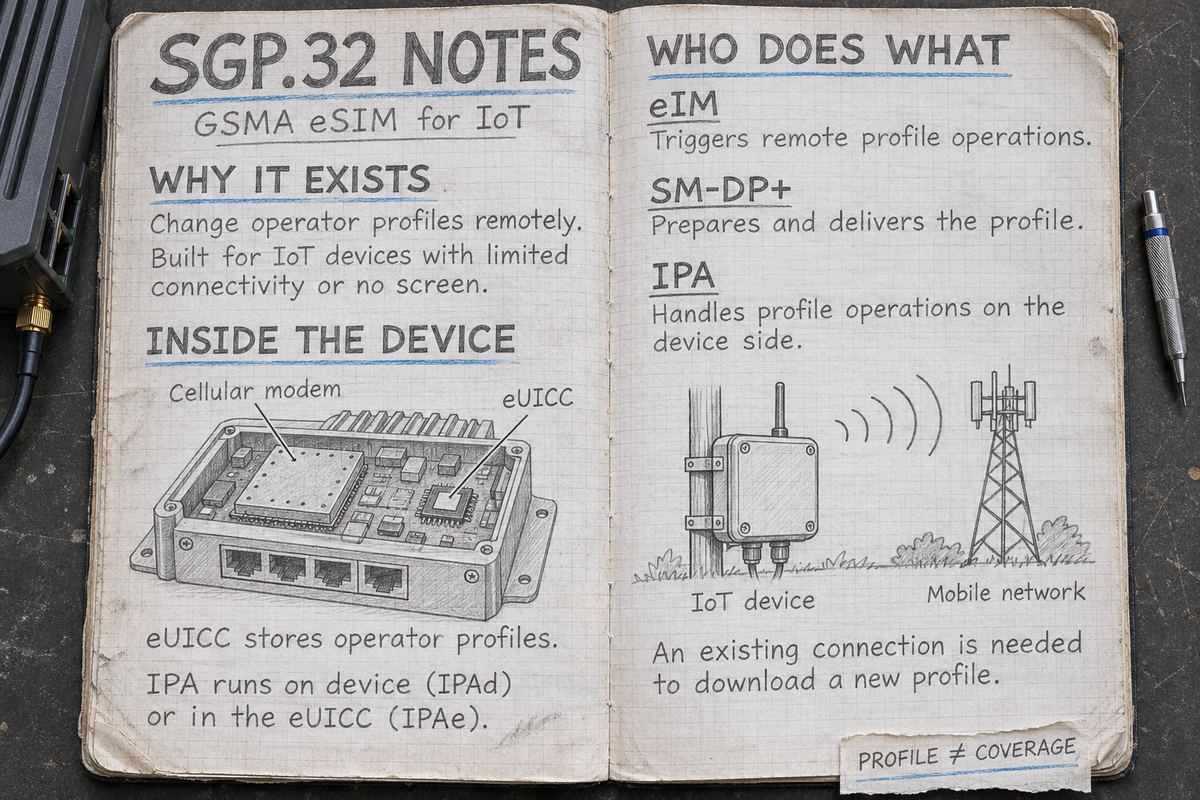
I keep this on one page of my notebook because it is the whole standard in four lines. Two pieces live in the cloud, two live in the device.
eIM
The eSIM IoT remote Manager. Triggers remote profile operations across your fleet. You, your connectivity provider or a specialist can run it.
SM-DP+
The operator-side server. Prepares, encrypts and delivers each profile so only the target chip can install it.
IPA
The IoT Profile Assistant. Handles profile operations on the device side, taking orders from the eIM.
eUICC
The chip. Stores operator profiles and their keys, and enables or disables them on instruction.
The eIM is the new idea. In consumer eSIM the person holding the phone is the decision maker; in SGP.32 the eIM stands in for that person, at the scale of ten thousand devices rather than one. Whoever controls the eIM controls the fleet, which is why chapter 11 matters so much.
Go deeper: SGP.32 architecture explained · esimiotmanager.com, the eIM in depth
Chapter 4Inside the device: eUICC and IPA
Inside an SGP.32 router or sensor there are two things to look for. The eUICC stores the operator profiles. The IPA can sit in one of two places, and the choice affects which hardware you can buy.
| IPAd (in the device) | IPAe (in the eUICC) | |
|---|---|---|
| Where the code runs | Device firmware or the modem | Inside the eSIM chip itself |
| Who maintains it | The device maker | The chip vendor |
| Modem requirements | Firmware support from the device maker | Modem must support the SIM toolkit features the chip relies on (such as BIP) |
| Best fit | Routers and gateways with capable firmware | Simple modules and sensors, or retrofits |
My rule of thumb: if the device maker cannot tell you where the IPA lives, they have not done SGP.32 yet. Ask before you order samples.
Go deeper: IPAe vs IPAd · How OEMs add eSIM to hardware
Chapter 5How a profile switch works
- You decide. In the eIM, you pick which devices move to which operator, and when.
- The profile is prepared. The eIM arranges a profile with the new operator’s SM-DP+.
- The device is told. The eIM sends a signed instruction to the IPA, over HTTPS or, for low-power devices, CoAP with DTLS.
- The download happens. The IPA fetches the encrypted profile from the SM-DP+ over the device’s current connection.
- The chip switches. The eUICC installs and enables the new profile and the device attaches to the new network.
- The result is reported. Success or failure goes back to the eIM. If the new profile cannot connect, the device can fall back to one that works.
Devices that sleep for hours are not a problem: the eIM queues the instruction and the device collects it when it next wakes. Plan switches in waves rather than all at once, so a bad profile hits ten devices, not ten thousand.
Go deeper: What is eSIM switching? · eSIM switching for IoT · The missing layer: switching platforms
Chapter 6Bootstrap: the connection before the connection
One line in my notes catches more people out than anything else: an existing connection is needed to download a new profile. A device with no working profile cannot fetch one. So every SGP.32 device ships with a bootstrap profile, the first network it uses to reach the eIM and collect its operational profile.
| Question | Why it matters |
|---|---|
| Who provides the bootstrap profile? | It is often the chip vendor or connectivity provider, and it shapes who you deal with first |
| Does it have coverage where you install? | A bootstrap that cannot attach on site means a device that never activates |
| How long does it stay usable? | Devices stored for a year before install still need a working bootstrap |
| Can it be used as a fallback? | A bootstrap kept as a last resort profile can rescue a device after a bad switch |
| What does it cost? | Some providers charge for bootstrap data or activation, so get it in writing |
Go deeper: eSIM bootstrap issues · How to choose a bootstrap provider · Teltonika, Tele2 and the SGP.32 bootstrap
Chapter 7Profile is not coverage
The note stuck to the bottom of my notebook page says it all: profile ≠ coverage. Loading a new operator’s profile changes which network the device is allowed to use. It does not improve the signal in a basement, fix a poor antenna or put a mast where there is none.
What a new profile fixes
A network closing, a contract ending, a price that is too high, permanent roaming rules, or one operator that is genuinely stronger at a site.
What it does not fix
Weak signal from poor antenna placement, a building that blocks radio, a modem that lacks the right bands, or a site with no coverage from anyone.
Before blaming the network, check the radio. A signal survey and a decent external antenna solve more “coverage problems” than any profile switch ever will.
Go deeper: Multi-network SIMs are not a magic bullet · The eSIM network landscape
Chapter 8Versions and certification
| Version | Published | What it means for you |
|---|---|---|
| v1.0 / v1.0.1 | May and July 2023 | The first IoT eSIM specification. Early implementations |
| v1.1 | April 2024 | Corrections and clarifications from early testing |
| v1.2 | June 2024 | The certification baseline. Most products in 2026 and 2027 are “v1.2 compliant” |
| v1.3 | May 2026 | The latest version, published alongside SGP.31 v1.3 |
“SGP.32 compliant” on its own means very little. Ask three things: which version, whether the eUICC is certified, and whether the eIM has passed testing against the same version. A supplier who answers all three without hesitation has done the work.
Go deeper: SGP.32 v1.2: the certification baseline · What changed in v1.3
Chapter 9Is your hardware ready?
Most SGP.32 failures I hear about are not network problems. They are hardware problems found too late. A modem that cannot run the SIM toolkit commands the chip needs, firmware with no IPA, or a router sold as “eSIM ready” that only supports consumer SGP.22.
| Check | What good looks like |
|---|---|
| Modem support | Confirmed support for BIP and the SIM toolkit features the eUICC uses, on the firmware you will ship |
| IPA location | The vendor can say IPAd or IPAe, and show it working |
| Standard | SGP.32, not SGP.22 labelled as “IoT eSIM” |
| Firmware updates | A clear route to update the IPA and modem firmware in the field |
| Proof | A live switch demonstrated on your sample, with your chosen eIM |
Go deeper: Is your modem really ready for SGP.32? · SGP.32 routers and gateways · What to ask your hardware provider · Which routers actually support SGP.32?
Chapter 10Security and regulation
Every SGP.32 profile operation is signed, encrypted and logged. Profiles are bound to one specific chip, so an intercepted profile is useless anywhere else. That audit trail is becoming more valuable as regulation tightens.
| Rule | Status | Why it touches eSIM |
|---|---|---|
| UK PSTI Act | In force since April 2024 | Security basics for connectable consumer products, including update support periods |
| EU Cyber Resilience Act | Vulnerability reporting from September 2026; main obligations from December 2027 | Products with digital elements sold in the EU need secure update and vulnerability handling, which covers connectivity firmware |
The practical step: treat the eIM and IPA as part of your product’s security design, not as a connectivity extra. Ask who holds the keys, where logs are kept and how long for.
Go deeper: SGP.32 security
Chapter 11Lock-in: where it moved to
SGP.32 removed lock-in from the architecture. It did not remove it from contracts. The control that used to sit with one operator’s SM-SR now sits with whoever runs your eIM and your bootstrap profile.
| eIM model | What you get | Watch for |
|---|---|---|
| Provider runs its own eIM | One supplier, one bill, fastest start | Whether the provider lets you load another operator’s profile, and on what terms |
| Provider uses a partner eIM | Proven platform, provider handles the relationship | Two parties in the chain when something goes wrong |
| You run or choose the eIM | Most control over operator choice | More integration work and more responsibility |
The question I always ask: “If I leave you, can my devices be moved to another eIM, and what does that cost?” eIM portability is still maturing, so get the answer in the contract, not in a sales call.
Go deeper: SGP.32 didn’t end lock-in, it moved it · eIM portability · UK providers by eIM model
Chapter 12The business case
The saving rarely comes from a cheaper data tariff. It comes from the engineer visits you never make and the hardware you never replace.
| Cost line | Physical SIM | SGP.32 eSIM |
|---|---|---|
| Changing network | Site visit per device | Remote, in waves |
| Product variants | One SKU per market or operator | One SKU worldwide, localised later |
| Contract renewal | Little leverage once deployed | A credible threat to move |
| Network closures | Replace or revisit devices | Move profiles before the switch-off |
| Upfront | Cheapest SIM | Higher chip and platform cost |
If your devices are cheap, few and easy to reach, a physical SIM may still win. If they are spread out, hard to reach or meant to last ten years, the numbers usually favour SGP.32 quickly.
Go deeper: The real cost of a physical SIM · eSIM benefits for end users · eSIM lifecycle: factory to field
Chapter 13Choosing a provider in the UK
The UK has three host networks for IoT (EE, VodafoneThree and Virgin Media O2) and a long list of IoT specialists and international providers selling SGP.32 on top of them. I track them all in the UK SGP.32 network directory, with a page for each provider covering its history, its SGP.32 status, its eIM model and how to contact it.
| If you need | Start with |
|---|---|
| A UK-based provider and account manager | Wireless Logic, Eseye, Pelion |
| A provider running its own eIM | Kigen, Telenor IoT, Soracom, emnify, Onomondo, 1GLOBAL |
| A UK host network direct | Vodafone IoT, EE and BT, Virgin Media O2 |
| The full side-by-side view | The directory comparison table |
For products and services across IoT more widely, the IoT Portal Directory is a good next stop.
Go deeper: What to ask an eSIM provider · SGP.32 in the RFP · The UK SGP.32 landscape
Chapter 14What 2027 looks like
These are my expectations, not forecasts from the GSMA. I will mark them right or wrong in the 2028 edition.
SGP.32 in the RFP by default
Large tenders already ask for it. In 2027 I expect smaller buyers to do the same, and SGP.02-only offers to struggle.
v1.3 products arrive
Certification against v1.3 should start to appear, but v1.2 will remain the baseline most of the year.
eIM portability gets tested
The first real moves of fleets between eIMs will show which promises hold. Watch for public case studies.
Hardware catches up
More routers and modules will ship with a working IPA out of the box, and “eSIM ready” claims will be easier to check.
Regulation drives adoption
The EU Cyber Resilience Act deadline in December 2027 will push makers to sort out secure updates, including connectivity.
2G planning starts
The UK plans to switch off 2G by 2033. Long-life devices bought in 2027 will need a clear answer for that date, and eSIM is part of it.
Go deeper: The future of eSIM and eUICC · SGP.32 challenges and traps
The 2027 buyer’s checklist
Print this, take it into your next supplier meeting, and do not sign until every line is answered.
- The device follows SGP.32, not SGP.22 labelled as IoT eSIM
- The vendor can name the SGP.32 version and show certification for the eUICC
- The eIM is tested against the same version
- The IPA location (IPAd or IPAe) is known and demonstrated
- The modem firmware supports the SIM toolkit features the chip needs
- The bootstrap profile has coverage where you install, and a known cost
- A fallback profile is in place if a switch fails
- You know who runs the eIM and what it costs to leave
- At least two operator profiles are available to you, with prices
- Switches can be scheduled in waves, with reporting
- Logs, keys and security responsibilities are written down
- A signal survey has been done, because profile is not coverage
Free PDF · 14 pages
Get The SGP.32 Handbook as a PDF
Print it, share it with your team, or take the buyer’s checklist into your next supplier meeting. I’ll email you a copy, plus one note on UK providers a few days later. Unsubscribe any time.
Handbook FAQ
What is the SGP.32 Handbook?
A free, chapter-by-chapter guide to IoT eSIM and the GSMA SGP.32 standard, written by Peter Green for sgp32.co.uk. It covers the standards, the components, hardware readiness, security, lock-in, the business case and choosing a UK provider, with a buyer's checklist for 2027.
Is SGP.32 the same as eSIM?
No. eSIM describes the chip and the idea of downloadable SIM profiles. SGP.32 is one GSMA standard for managing eSIM in IoT devices remotely, alongside SGP.02 for older M2M and SGP.22 for phones and watches.
Do I need an eIM to use SGP.32?
Yes. The eIM is the cloud platform that sends profile instructions to your devices. You can run your own, use your connectivity provider's or pick a specialist, but every SGP.32 deployment needs one.
Can an SGP.32 device switch network with no signal?
No. An existing connection is needed to download a new profile. That is why every device ships with a bootstrap profile, and why a fallback profile is worth keeping.
Will switching profile improve my signal?
Only if another operator genuinely has better coverage at that site. A new profile does not fix a poor antenna, a building that blocks radio or a modem without the right bands. Profile is not coverage.
Which SGP.32 version should I ask for in 2027?
Ask for products certified against v1.2, the current certification baseline, and ask about the supplier's plans for v1.3, published in May 2026.
Which UK providers support SGP.32?
The sgp32.co.uk UK SGP.32 network directory lists every provider serving British customers, with its SGP.32 status, eIM model and contact details, plus a side-by-side comparison table.
How often is the handbook updated?
It is revised whenever the standard or the UK market changes, and re-issued each year. This is the 2027 edition, last revised on 24 November 2026.
About this handbook. Written and maintained by Peter Green for sgp32.co.uk. 2027 edition, last revised 24 November 2026. Spotted something out of date? That is exactly the kind of thing I want to hear about. Start with What is SGP.32? or browse the UK provider directory.